


DevOps Engineer vs Software Engineer: Key Differences
When talking about modern software development, few roles spark as much debate as the roles of DevOps Engineer vs Software Engineer. Organizations realize they require both people, but the distinction is not always clear. At GKM IT, we have the privilege of working with organizations across multiple industries to create a team structure where software engineers and DevOps engineers work together seamlessly. This balance provides efficiency, scalability, and sustainable digital success for organizations.
Defining The Roles
Software Engineers: The Builders of Digital Products
Software engineering encompasses the structures and compositions of applications. On a daily basis, software engineers are writing code and designing systems. They ensure every feature meets the user’s desired expectations. As a software engineer, you live and breathe problem-solving, algorithms, programming languages, and creating software that works effectively in the real-world environment.
DevOps Engineers: The Enablers of Speed and Scale
In contrast, a DevOps engineer is operationally focused. The intent is to allow software to move smoothly from development to deployment. DevOps engineers manage automation, CI/CD pipelines, infrastructure, and monitoring. This role exists to bridge the gap between coding and IT operations.
This is where the DevOps Engineer vs Software Engineer discussion becomes more about collaboration than comparison.
Core Differences in Focus
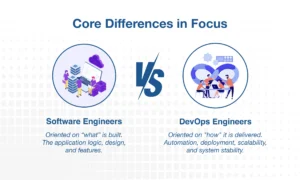
- Software Engineers: oriented on “what” is built. The application logic, design, and features.
- DevOps Engineers: oriented on “how” it is delivered. Automation, deployment, scalability, and system stability.
For example, DevOps programmers might not be writing feature-rich code, but they are essential in scripting automation workflows to ensure that the software gets delivered to users quickly and in a secure manner.
At GKM IT, we design workflows that ensure these roles are integrated rather than isolated, allowing for better quality and more frequent delivery.
Tools and Technologies
The toolsets demonstrate the difference:
- Software Engineers make use of programming languages (Java, Python, C++), frameworks, and testing tools.
- DevOps Engineers become proficient with CI/CD tools, Docker, Kubernetes, Terraform, etc., along with cloud-native technologies.
Our teams at GKM IT have both skillsets, and they deliver end-to-end solutions where code quality and operational excellence have been brought together.
Collaboration Is the Key
The honest truth is that comparing a DevOps Engineer vs a Software Engineer is not as simple as choosing which role is “better.” It is more about the ways they can complement each other.
- Software engineers work with product managers, designers, and testers to build great products.
- DevOps engineers work with developers, IT operations, and security teams to ensure deployment and scalability.
At GKM IT, we encourage collaboration on every project we deliver. Our project process enables the innovation (engineers) and execution (DevOps) to fit seamlessly together.
Skill Sets That Matter
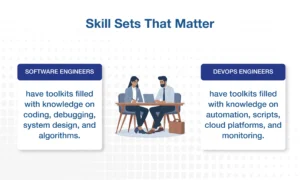
- Software Engineers have toolkits filled with knowledge on coding, debugging, system design, and algorithms.
- DevOps Engineers have toolkits filled with knowledge on automation, scripts, cloud platforms, and monitoring.
By choosing GKM IT, an organization never has to choose; we offer both. Our blended teams work on products that are well-built, kept in good repair, and quickly delivered.
Career Path and Business Relevance
- Software Engineers mature into architectural and engineering leaders.
- DevOps Engineers transform, based on their trajectory, into SREs, cloud architects, or consultants.
GKM IT offers DevOps consulting, where experts analyze workflows, identify bottlenecks, and advise companies on best practices for their use cases. Businesses are able to gain technical acumen as well as strategic insights about scaling their digital offerings.
Demand and Industry Impact
Both roles are in demand, but DevOps adoption rates are going up. Companies that commit to a DevOps Engineer and a Software Engineer working together will often report quicker release cycles, fewer failures, and higher customer satisfaction.
Our clients choose GKM IT for this very reason. We don’t merely support the development of software; we develop the conditions that support software. Our developers and DevOps engineers build technological conditions to ensure technology provides measurable business value.
Why Businesses Need Both
Imagine it the same way as creating and delivering a luxurious car:
- The software engineers are the designers and builders who make the car.
- The DevOps engineers make sure the assembly line is running seamlessly, cars are delivered on time to dealerships, and the delivery is impeccably executed.
At GKM IT, we fulfill both roles for our clients; by building some amazing digital products and deploying and scaling them flawlessly.
Final Thoughts
Ultimately, when we think about DevOps Engineer vs Software Engineer, the lesson is simple: success isn’t about one role over the other but rather that both roles point to common goals.
- Software engineers make the applications work.
- DevOps engineers make sure those applications work for users reliably at scale.
At GKM IT, we capture both environments. Whether you require custom software development, DevOps integration, or simply DevOps consultation, our teams are dedicated to delivering solutions that grow and prepare for your future.
In today’s digital world, where speed and reliability are a must, GKM IT has you covered, and you can trust that we have the right balance of innovation and execution.


